I was at 4 year-old Isabel’s house yesterday and she had a family project to do, sent home from preschool. She had a drawing of a turkey with three directions: cut it out, glue it on thick paper and “disguise” the turkey so it can escape being eaten on Thanksgiving!
Isabel had decided to disguise her turkey as a ballerina. She and mom carefully selected glitter markers (with lots of pink!), pink curly ribbons and stickers. As she followed the 3 directions (by two years a child should be able to follow two directions and by three years of age, three directions), her ballerina turkey was slowly covered up with a variety of materials.
I asked Isabel, “What is a disguise?” She mentioned that you can’t be seen, talked about a mask, and how people can’t find you. What a wonderful language lesson to talk about a concept and give examples of what are some disguises and when we want to “hide.” Having just had Halloween, many ideas popped up. A fun book to go along with this theme, The Featherless Chicken, is all about disguises and being accepted for who you are! Check it out. It is a favorite of mine.
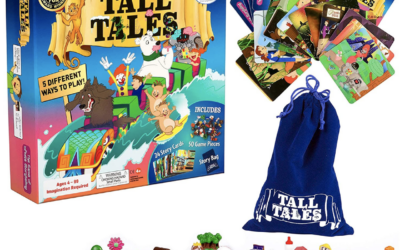
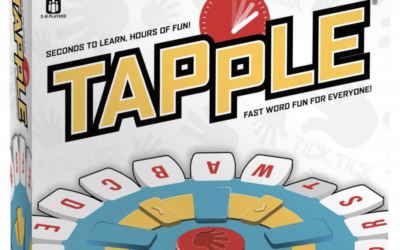
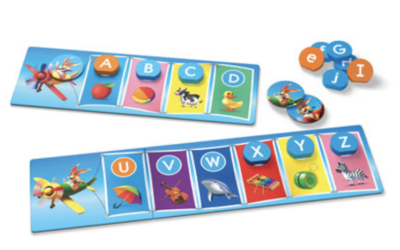
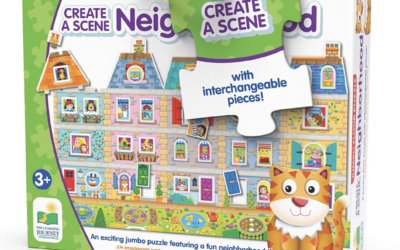
Parents often ask me for good game ideas for their kids. Today a mom wrote down every game I played with her son directly to her Christmas list! Here are some new games I tried out this week that are fun, educational and challenging.
Pirates Undercover by Educational Insights is a puzzle lover’s delight! Kids from 5 and up are challenged to use the 4 puzzle pieces to hide the pirate ships, rowboats, islands, and treasure and only reveal what is pictured on each page of the challenge book. The book provides 48 pages of images that must be left uncovered to master that challenge–from “starter” to “expert” to “master.” Parents want games they can play as a family and this is one of them. It can even be played alone, as a challenging puzzle requiring strategy and logic.
Last Word by Buffalo Games is “an uproarious race to have the final say.” Aged for 8 and up, this game of naming in categories can be adapted to a younger set so you can play it as a family. Turn over a subject card like “things is a purse” or “things that you fold”, and pick a letter card to begin your words. Start the timer and you are off! Everyone yells out words belonging in that category until the buzzer goes off. The last player to say a word advances on the game board. So far every child I’ve played this with has gotten louder and louder as they get excited trying to race against the timer and fill the time with their word entries. To adapt this game to the younger set, just skip the letter card and name things in the category. What a great game to strengthen vocabulary, naming in a category, and speed in calling up words.
I’ve been working with several elementary aged children to build their language skills. I always find that rich children’s literature holds their attention, stretches their vocabulary, and builds reasoning skills. Recently, I used two books that I would recommend for grades 3-5 (although I also used them with a second grader):
Fiddlin’ Sam by Dengler and The Raft by LaMarche.
Fiddlin’ Sam uses southern dialogue which brings about discussion on different ways to say things. Sam is a roving character who entertains through his music while traveling the back roads of the Ozarks. The tale takes you through the south as he fiddles for a meal or overnight lodging. The story unfolds as Sam searches for his successor as his father left him with, “This ain’t a gift, it’s a loan. You gotta pass the music along.” There is enough abstract language and inference to question and discuss to deepen a child’s language skills.
The Raft deals with a reluctant little boy who is sent to spend the summer with Grandma on a river. Mystery is created around his grandma as he enters her artistic world of sketches and sculptures from the habitat that surrounds her. When a raft floats up, covered with drawings of animals, the boy is drawn into the river life and learns of the special attraction the raft has to river wildlife.
What read alouds have your found to be rich with vocabulary, inference and storylines to launch storytelling? Leave them in the comments and I will share them with everyone.
One of the enjoyable parts of my job is that I occasionally get to go and see one of my little clients in their preschool setting and work with them there, observing how their language impacts their relationship with peers as well as play and academics.
Today I had the privilege of visiting Eva at her preschool. She immediately introduced me as Sherry to all of her fellow pretenders in “The Doctor’s Office.” Several medical coats were available to put on as well as implements to deliver shots, finger pricks, heart checks and blood pressure screenings. At one point I was covered with band aids as a child banged my knee with his hammer to perform his professional duties. The cutest part was that the “doctors” each had a kid-sized clipboard and after they executed their medical checks they “wrote down” what procedures they had used. What a great way to integrate writing and inventive spelling into fun pretend play! They added “finger prick,” “temperature” and “throw up” to their list after each duty or event. Watching them sound out the words and transcribe their actions was captivating.
You can set up this combination of creative play and letter learning at home. Brainstorm with your child possible play settings such as a pirate ship, grocery store, train station or beauty parlor. Most businesses involve money that can be printed with words, or tickets to get on the train. Help your child make these ahead or write them out as needed. Children learn best in their natural environment of play–rather than flashcards–because words have meaning in context. They learn that a word stands for something and is useful in their play scheme. Always have plenty of paper and pencils around their pretend play area and see how your children integrate the written word into their play naturally.
Okay here is another tip for saving money–or should I say spend no money–on educational toys.
I was at 3 year-old William’s house yesterday. He is building his skills in pretend play, picking up little Fisher Price people and having conversations around a theme of the zoo, train station, pirate ship or parking garage. Mom is always looking for ideas on how to build William’s language through play. Without buying new toys regularly I suggested that she swap with friends. Trade 2 or 3 favorites for a month. It’s not a bad idea to rotate toys anyways, so kids have a renewed interest in them when they return.
Many of you Moms and Dads are in play groups where you bring a few toys to amuse your child in the group. Observe what captures your child’s interest and suggest a swap for a week or two. A new toy gives you, the parent, something new to talk about as you describe a baby toy or use a preschooler’s pretend toy in a new way. Your running commentary about the toy, it’s features, function and actions all build up your child’s language skills.
Let me know what your ideas are for saving money on educational toys, media or games. Leave a comment and I will share everyone’s ideas. Thanks!
Being a parent is hard work and as we all know, rewarding–sometimes when we least expect it.
For my birthday present my oldest son asked me into New York City for the day to go to two art museums. My invitation came on a post card of the Miro exhibit at the MOMA. We both share a love of art and especially enjoy the Museum of Modern Art.
As we slowly made our way through the exhibits, pointing out interesting facts and sharing drawings we particularly liked, I was reminded of the many family vacations when the boys were young and I would add an art museum on to the itinerary of tours of submarines and aircraft carriers. In those days, I would try to hold the boys back, encouraging them to take a longer look or actually read the information next to the pictures, giving relevant background on the art. Naturally they sped through the exhibits and headed for the “museum store” to buy some trinket. I never knew if my efforts were worth it:)
I found an inexpensive way to satisfy their desire to get a souvenir was to let them pick out postcards of the art that they liked the best. It was always fascinating to see what they picked out. Sometimes it was something I remembered and sometimes not. No matter what, they liked it and could talk about the art and what was interesting to them. These postcards served to be a memory card of our trips, and gave them a launching pad for discussion–feeling very important with their choices.
As you know, I love art, and feel it can be used to elicit language and make some very creative and abstract connections verbally. I used to work with a speech pathologist who used large posters of paintings to describe with children on the autism spectrum. I thought that was very innovative.
So, I guess I went full circle as a mom yesterday. I got my little postcard to invite me to an art museum to go at an adult pace with my young adult son. Maybe dragging three little boys through art museums was worth it after all.
For more ideas on how to combine learning and fun when taking your children to an art museum, go to Parents’ Choice website.
I work with several kids to build their oral language skills that then relate to their writing skills. Research shows that oral vocabulary is linked to a child’s reading ability and certainly impacts their writing skills also. As kids progress through elementary school they are expected to use more elaborate words, describing emotions, senses, situations and problems.
Yesterday I had fun making a thesaurus with a fourth grader. Chole is enjoying revising her writing to include more intricate vocabulary, conjunctions like because and so, and descriptive words. She has enjoyed revising her work by taking a “younger” word like “big”, looking it up online in a thesaurus, www.thesaurus.com, and finding a new gem to use like “gigantic” or “enormous.” Together we decided to make her own thesaurus to use when she is stuck, looking for a new word in her writing.
I bought her a fun journal and got sticky ABC tabs to attach every few pages. She was off, entering her words and synonyms to be used as reference. She immediately entered “small” and came up with tiny, miniature, petite and minute. She felt ownership as she looked up the words that were meaningful to her and entered them into her new thesaurus.
If you don’t have time to make your own, check out your local bookstore for an age-appropriate thesaurus. Scholastic makes a series of student help guides including a thesaurus. Check the ages so it will fit your child.
Part of being a speech-language pathologist is looking a bit like Mary Poppins with our bags of toys and materials to excite and stimulate kids’ language. My brother actually asked me recently what I was doing to work out since my arms looked firm:) I just laughed and said I lift these heavy bags of toys every day.
Good news. I was just given a wonderful kit to review called “Come Learn With Me” by Back Country Kids, Inc. All the objects, pictures, books and reinforcers come in a light weight canvas zip up bag. You can’t believe all that it contains.
Designed for use with preschoolers with speech and language delay and disorders (up to age 5), this kit includes bags of objects by category–farm, things to ride, food, and by function. Laminated spiral books with simple backgrounds also address each category and have 66 laminated pictures to flexibly interchange on the pages, attaching with Velcro.The manual is well-organized, breaking down objectives within receptive and expressive language and cognitive skills. The ease of use makes this kit an appropriate tool to share with parents to reinforce goals that you are working on. Parents want to be involved and see what level their child is performing at.
Designed by three early childhood experts and speech-language pathologists, this kit grew out of their experience and need for materials to engage preschoolers working on language goals. Kids love the cartoon-like drawings and “ripping” off the pictures and applying them to the Velcro dots in the books. Data can easily be collected on a chart at the front of each book using dry erase pens.
For a detailed description of the kit see the website for “Come Learn With Me”.
Also for my complete review go to my Review.
I visit many area preschools, sometimes doing therapy within a child’s school setting, just observing or giving in-service training to teachers and staff.
Last week I went to a preschool that was new to me. I was impressed with two things I wanted to share with you.
As I walked in the entry way, I was met with an inviting display of books, organized by author and then grouped by theme–holidays, seasons, events etc. A teacher could grab a section on Halloween or autumn, or get a good read-aloud from the selection. Kids could check out books to bring home. Does your child’s school have a lending library? If not, why not start one? Get the kids involved, donating books or finding families that have passed the preschool age and would be willing to donate gently used ones when they clean out.
When I got the classroom, I saw a parent seated with a child, writing in what I found out was his “journal.” Each 3 year-old had his own journal, a three ring binder, that collected his artwork, and pictures of him participating in various activities in the classroom. Parents volunteer to come in and annotate the journal, writing down the child’s description of their masterpieces and the photos that illustrate their day. What a great language builder–not only when the child provides the commentary, but also when an adult asks them to describe and tell about the photographs. The kids are building memory as well as language skills, reviewing what they did.
Let me know any other terrific ideas that are being done in your child’s preschool and I will share them here. Just post a comment and I will share it.
Advantages and Disadvantages of Delaying Kindergarten
There has been a growing trend over the last 20-30 years for parents to hold their children out of kindergarten until they’re older, many starting their children later than 5 years of age.
New research by Darren Dubotsky, PhD, and T. Elder, in the Journal of Human Resources, challenges that trend, suggesting that older children entering kindergarten have a short-lived advantage due to an extra year to learn skills. Once they enter school, all the students no matter what the age, learn at the same pace. At entry, older students scored better on tests than their younger peers but that gap narrows to less than 4 percent by eighth grade. The researchers say that if students that are older at entry to kindergarten learned at a faster pace, this would be reflected as they progress through the grades, which is contrary to what they found.
There are both positive and negative effects of having children in class that vary in age. Younger students tend to score higher on tests when they have older children in their class but the younger students tend to be compared to their older peers and may be more readily identified with learning problems.
As a parent, deciding on whether to send your child to kindergarten or hold him back a year is a daunting question. I always advise parents to listen to their child’s preschool teacher’s input since they know if your child has some of the social skills needed to be available to learn—sitting still, listening, waiting his turn, sharing, taking turns, paying attention and so on. Most kindergarten teachers I have talked to say that if these social skills are in place, they can teach children what they need to know.